Working out is an exciting and a challenging experience, particularly when one is a beginner. The process of becoming fit is full of growth opportunities, yet it is equally challenging, and especially in terms of form and progress. These two key considerations are crucial to achieving safety and maximum outcomes and a lifetime devotion to fitness. The principles of correct exercise form, method of progression, and advice to a beginner will be discussed in this blog post to establish an effective workout regime.
The Importance of Proper Form
Correct shape is essential in any workout. Not only it helps to avoid injuries but also makes sure that you are training the necessary muscle groups. The following are just some of the reasons why it is crucial to keep good form:
1. Injury Prevention
Poor form may cause muscle strains, joint injuries, as well as other severe problems. Inexperienced people are prone to injury because they do not have experience and do not know how to do exercises properly. The following are several ways of making it safe:
- Mistakes to avoid: Rounding the back during lifts, locking out joints and using momentum instead of muscle control are some of the common mistakes. Having the knowledge of these mistakes can assist you to concentrate on good form.
- Listening to Your Body: You should listen to the way your body feels when exercising. In case of pain (not of muscle fatigue), your form might be wrong, and you need to stop and review.
2. Maximizing Effectiveness
A proper form means that you are using the right muscles when doing the exercises thus the results will be more successful. The following are the ways to maximize effectiveness:
- Exercising in the correct manner: When you train in the right way, then you actually work the targeted muscle groups. Take the case of a squat, in this case, you should make sure that your glutes, hamstrings, and quadriceps are engaged and this is only possible with a proper form.
- Improving Performance: This is simply doing things in the correct form and someday this will go up into improving your overall performance. The weaker and less experienced you are, the more easily you might be able to advance and make your exercises more serious.
3. Building a Strong Foundation
Learning proper form from the beginning sets the stage for future progress. Here’s how a solid foundation benefits you:
- Skill Development: Mastering the basics allows you to build on your skills as you advance in your fitness journey. A strong foundation makes it easier to learn more complex movements and exercises.
- Confidence: As you become comfortable with your form, your confidence in the gym will grow. This confidence can lead to increased motivation and consistency in your workouts.
Key Principles of Proper Form
To help beginners understand proper form, we’ll explore some foundational exercises and the key principles associated with each.
1. Squats
Squats are a fundamental lower-body exercise that targets the glutes, quadriceps, and hamstrings. Here’s how to perform a squat with proper form:
- Foot Position: Stand with your feet shoulder-width apart and your toes slightly pointed outward.
- Engage Your Core: Tighten your core muscles to support your spine throughout the movement.
- Descent: Begin by pushing your hips back as if you’re sitting in a chair. Bend your knees and lower your body, keeping your chest up and back straight. Your knees should track over your toes but not extend beyond them.
- Depth: Aim to lower your body until your thighs are parallel to the ground. If this is challenging, go as low as you can while maintaining proper form.
- Ascent: Press through your heels to return to the starting position, ensuring your knees remain aligned with your toes.
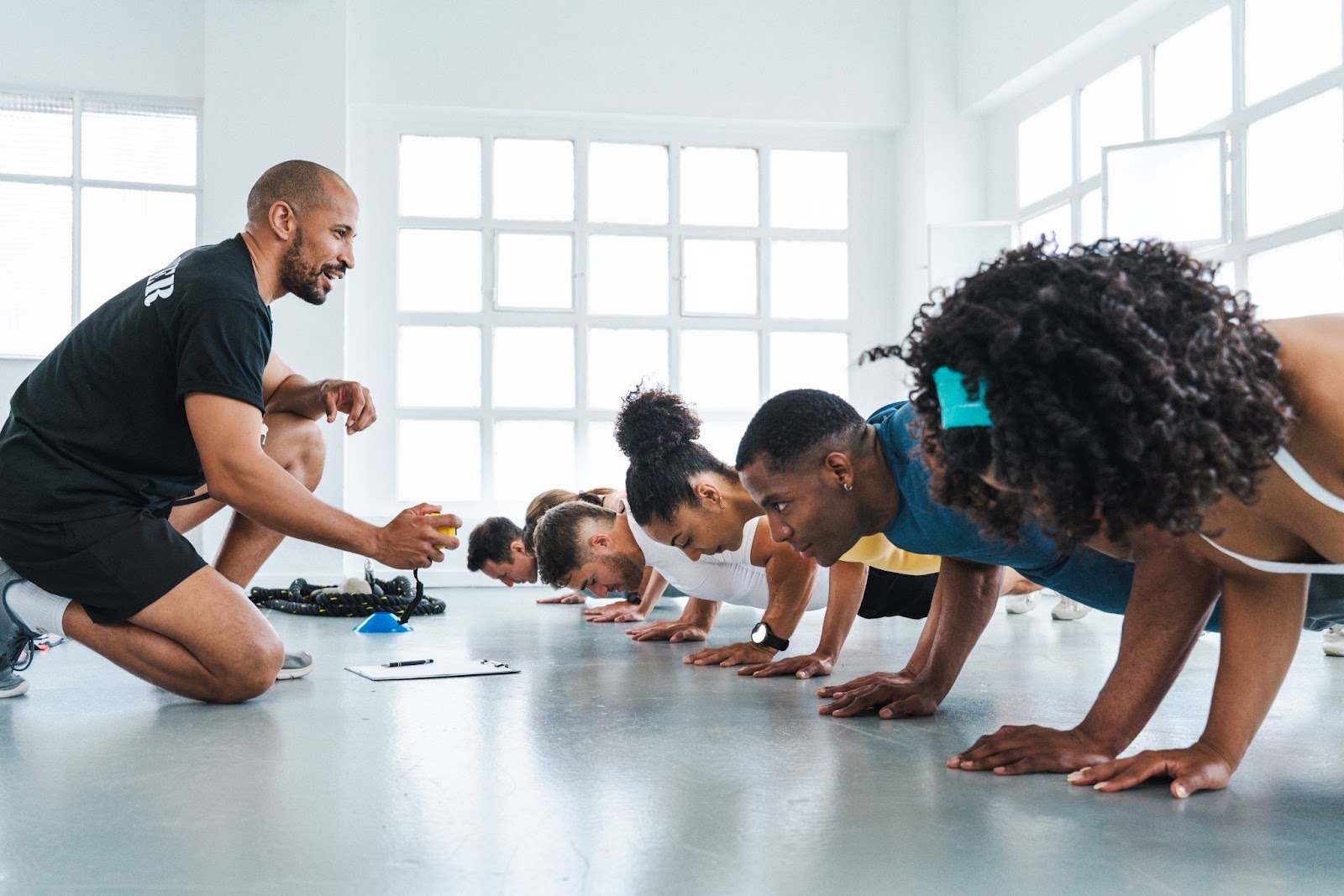
2. Push-Ups
Push-ups are a classic upper-body exercise that targets the chest, shoulders, and triceps. Here’s how to perform a push-up correctly:
- Hand Position: Begin in a plank position with your hands slightly wider than shoulder-width apart.
- Body Alignment: Keep your body in a straight line from your head to your heels. Avoid sagging your hips or arching your back.
- Descent: Lower your body by bending your elbows, keeping them close to your sides. Go down until your chest nearly touches the ground.
- Ascent: Push through your palms to return to the starting position, maintaining a straight line with your body.
3. Deadlifts
Deadlifts are a compound exercise that targets multiple muscle groups, including the glutes, hamstrings, and lower back. Here’s how to perform a deadlift with proper form:
- Foot Position: Stand with your feet hip-width apart, with the barbell (or dumbbells) positioned over the midfoot.
- Grip: Bend at the hips and knees to grasp the bar with an overhand grip, keeping your arms just outside your knees.
- Back Position: Keep your back straight and chest up. Your shoulders should be slightly in front of the bar.
- Lift: Push through your heels and extend your hips and knees simultaneously to lift the bar. Keep it close to your body as you stand up.
- Lowering: Reverse the movement by pushing your hips back and bending your knees to lower the bar back to the ground.
4. Planks
Planks are an excellent exercise for building core strength. Here’s how to perform a plank correctly:
- Starting Position: Begin in a push-up position with your forearms on the ground and elbows directly beneath your shoulders.
- Body Alignment: Keep your body in a straight line from your head to your heels. Engage your core and glutes to maintain stability.
- Hold: Aim to hold the plank position for as long as you can while maintaining proper form. Start with shorter durations and gradually increase as you build strength.
Progression Techniques for Beginners
Once you have a solid understanding of proper form, the next step is to learn how to progress in your workouts safely. Progression is essential for continued improvement in strength, endurance, and overall fitness. Here are some effective progression techniques:
1. Increase Resistance
One of the most straightforward ways to progress is by increasing the resistance or weight you use during exercises. Here’s how to do it safely:
- Gradual Increases: Increase the weight by small increments (2.5 to 5 pounds) to allow your body to adapt. This gradual approach helps prevent injury and ensures that you maintain proper form.
- Challenge Yourself: If you can comfortably perform the prescribed number of repetitions with good form, it may be time to increase the resistance.
2. Increase Repetitions and Sets
Another way to progress is by increasing the number of repetitions or sets you perform. Here’s how to implement this technique:
- Repetition Goals: Aim to increase the number of repetitions for each exercise gradually. For example, if you start with 8 reps, aim for 10 reps, then 12 reps, and so on.
- Additional Sets: Once you can comfortably perform the desired number of repetitions, consider adding an additional set to your workout. This increase in volume can enhance strength and endurance.
3. Decrease Rest Time
Reducing the amount of rest time between sets can increase the intensity of your workouts. Here’s how to do it effectively:
- Monitor Rest Duration: Keep track of the time you rest between sets. Gradually decrease the rest time by 15-30 seconds to challenge your cardiovascular system and muscular endurance.
- Listen to Your Body: While decreasing rest time can be effective, it’s essential to listen to your body. If you feel overly fatigued or unable to maintain proper form, allow for longer rest periods as needed.
4. Incorporate Variations
Introducing variations of exercises can provide new challenges and stimulus for your muscles. Here’s how to add variety to your routine:
- Exercise Modifications: For example, if you’re comfortable with push-ups, try variations such as incline push-ups (feet elevated) or decline push-ups (hands elevated) to increase difficulty.
- New Exercises: Incorporate new exercises that target the same muscle groups. For instance, if you typically perform squats, try lunges or step-ups for variety.
5. Focus on Time Under Tension
Time under tension refers to the amount of time your muscles are engaged during an exercise. Here’s how to incorporate this principle:
- Slow Down Reps: Perform exercises at a slower pace, focusing on the eccentric (lowering) phase of the movement. For example, lower yourself during a squat over a count of three seconds before rising.
- Isometric Holds: Incorporate isometric holds at the peak of exercises (e.g., holding the bottom position of a squat) to increase the time your muscles are under tension.
Creating a Beginner Workout Routine
Now that you understand proper form and progression techniques, it’s time to put it all together and create a beginner workout routine. Here’s a simple framework to get you started:
1. Determine Your Goals
Before creating your workout routine, identify your fitness goals. Are you looking to build strength, improve endurance, lose weight, or enhance overall fitness? Your goals will guide your workout choices.
2. Choose Your Frequency
Decide how many days a week you can realistically commit to working out. For beginners, 3 to 4 days a week is a great starting point. Here’s a sample weekly structure:
- Day 1: Full Body Strength Training
- Day 2: Cardio (e.g., running, cycling, swimming)
- Day 3: Rest or Active Recovery (e.g., yoga, walking)
- Day 4: Full Body Strength Training
- Day 5: Cardio
- Day 6: Rest or Active Recovery
- Day 7: Optional Total Body Workout or Outdoor Activity
3. Select Exercises
Choose a mix of exercises that target major muscle groups and incorporate both cardio and strength training. Here’s a sample workout plan:
Full Body Strength Workout (Day 1 & Day 4)
- Squats: 3 sets of 8-12 reps
- Push-Ups: 3 sets of 6-10 reps
- Dumbbell Rows: 3 sets of 8-12 reps (each arm)
- Planks: Hold for 20-30 seconds, 3 sets
- Deadlifts: 3 sets of 8-12 reps
Cardio Workout (Day 2 & Day 5)
- Brisk Walking or Jogging: 20-30 minutes
- Cycling: 20-30 minutes
- Swimming: 20-30 minutes
- HIIT Workout: 20 minutes (e.g., alternating between 30 seconds of high-intensity exercises and 30 seconds of rest)
4. Track Your Progress
Keep a workout journal or use fitness apps to track your workouts, progress, and goals. Documenting your journey can provide motivation and accountability.
5. Prioritize Recovery
Don’t forget to include recovery days in your routine. Use this time to rest, stretch, and engage in activities that promote recovery, such as foam rolling or gentle yoga.
Conclusion
Being a beginner to a workout program means that you might find it difficult to start a workout program, however, knowing the right form and progression will help you be successful in your workout program. When you concentrate on learning the proper techniques, building intensity gradually and developing a balanced exercise program you can have a successful fitness process.
It is important to bear in mind that fitness is not a one-time affair and that developing sustainable habits is a long process. You should be patient, and consistent and rejoice in your progress as you go. Provided you are willing and committed, it is possible to reach your fitness targets and experience all the perks of having a healthy lifestyle.